
Should You Tell Your Children About Infidelity? A Therapist's Guide for Parents
Clinical guidance for one of the hardest conversations parents never wanted to have
The discovery of infidelity sends shockwaves through every corner of a family's life. In the immediate aftermath — the tears, the arguments, the sleepless nights — one question quietly becomes urgent: What do we tell the kids?
There is no easy answer. But there is a clinically informed one. And understanding it could be the difference between protecting your children's emotional development and inadvertently drawing them into a wound that isn't theirs to carry.
This guide is written for parents navigating one of the most painful intersections in family therapy: the impact of infidelity on children, and how to handle disclosure in a way that prioritizes their well-being above all else.
The First Rule: Your Children Are Not Your Confidants
Before anything else, this boundary must be stated clearly and without qualification. Your children — regardless of age — should never be treated as emotional support, allies, or confidants in the aftermath of betrayal. This includes teenagers. This includes adult children living at home. This includes the child who seems mature beyond their years and "can handle it."
When parents cross this line — even with the best intentions — the clinical term is parentification: a role reversal in which the child is burdened with the emotional needs of the adult. The research on parentification is unambiguous. It is associated with anxiety, depression, impaired adult relationships, and lasting damage to the parent-child bond.
Your pain is real. Your need to be heard is valid. That need belongs to a therapist's office, a trusted friend's living room, or a support group — not in a conversation with your child.
Read more: Midlife Crisis or Awakening? Finding Purpose Beyond Routine.

How should parents talk to children about infidelity without causing emotional harm?
Should I Tell My Kids About Infidelity at All?
This is the question parents type into search engines at 2 a.m., and it deserves a direct answer.
In most cases, no — not the details. But some level of honest, age-appropriate acknowledgment is usually necessary.
Here is the clinical reasoning: children are extraordinarily perceptive. They feel the tension in a room before they can name it. They notice when a parent cries behind a closed door, when dinner conversation disappears, when Mom and Dad stop touching each other. If that emotional reality is met with "everything is fine," children do not conclude that everything is fine. They conclude that they are the problem — that something is wrong with them, or that they caused the disruption they can feel but cannot name.
Silence, in this context, is not protection. It is confusion handed to a child without a map. The goal is not full disclosure. It is honest, boundary acknowledgment that something difficult is happening between the adults, that it is not the child's fault, and that they are loved and safe.
Also, see our article about How to Talk to Your Loved One About Seeing a Sex Addiction Therapist.
Age-Appropriate Guidance: What to Actually Say
Young Children (Ages 4–8)
Young children need emotional safety and routine more than explanation. Their cognitive development does not yet allow them to process adult relational complexity — and attempting to explain it will produce anxiety, not understanding.
What to say: "Mom and Dad are having some grown-up problems right now. It has nothing to do with you, and we both love you very much. Some things might feel different for a while, but we are going to take care of you."
What not to say: Anything about a third party, the nature of the betrayal, or language that assigns blame.
Older Children (Ages 9–12)
Children in this age range are beginning to understand that adult relationships are complex, and they are more likely to ask direct questions. They also tend to be highly attuned to fairness and honesty — so dismissive non-answers can erode trust.
What to say: "Our relationship is going through something very hard right now. Adults sometimes make mistakes that hurt each other. We're working with a counselor to figure things out. None of this is about you."
What not to say: Do not name the affair. Do not describe what happened. Do not characterize the other parent as a villain, even if that characterization feels justified.
Teenagers (Ages 13–18)
Adolescents present the most complex disclosure challenge. They are cognitively capable of understanding infidelity, emotionally immature enough to be significantly destabilized by it, and old enough to find out on their own — through overheard conversations, text messages, or a well-meaning relative.
Many therapists recommend a slightly more direct acknowledgment with teenagers, precisely because the alternative — them discovering the truth independently — can cause far greater damage to trust in both parents.
What to say: "I want to be honest with you because I respect you. Our marriage is in a serious crisis right now. There was a betrayal of trust between us. We are getting professional help. This is between the two of us, and it does not change how either of us feels about you."
What not to say: Do not provide details. Do not ask for their opinion on what you should do. Do not position them as a confidant or ask them to keep secrets from the other parent.
Understand Online Sexual Addiction: Social Media, OnlyFans, and the New Frontiers of Compulsive Behavior.
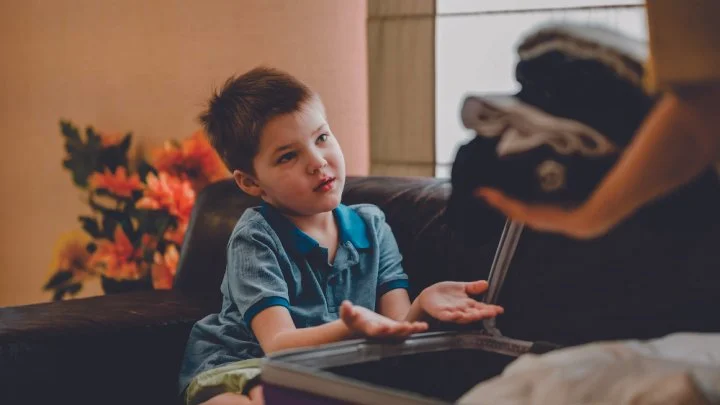
Age-appropriate guidance can protect children while acknowledging family changes.
The Impact of Infidelity on Children: What the Research Shows
Understanding the impact of infidelity on children is essential context for every decision parents make in this period.
Studies consistently find that it is not the infidelity itself that most damages children — it is parental conflict, emotional unavailability, and household instability in its aftermath. Children who grow up in homes where betrayal is handled with hostility, triangulation, or chaos show elevated rates of anxiety disorders, depression, and insecure attachment in adulthood.
Conversely, children whose parents manage the crisis with relative emotional regulation, maintained routines, and consistent reassurance show significantly more resilience — even when the marriage ultimately ends.
The protective factors are clear:
Maintained routine: School, activities, mealtimes, and bedtime routines signal safety.
Emotional availability: Even a parent in pain can say "I'm feeling sad today, but I'm here and I love you."
· United parenting front: Keep marital disagreements out of your children’s view.
Professional support: Individual therapy for each parent, couples therapy, and child therapy when indicated.
Also read the article: Rebuilding Trust: Steps for the Partner Who Cheated to Show True Remorse.
When to Involve a Child Therapist
Not every child needs therapy after parental infidelity. But certain signs warrant professional consultation:
Sudden changes in behavior, school performance, or social withdrawal
Increased clinginess, separation anxiety, or sleep disturbances in young children
Expressions of guilt or self-blame ("Did I do something wrong?")
Anger, aggression, or acting out that is new or significantly escalated
Adolescents who have learned details of the affair and are processing it alone
A child therapist provides a neutral, safe space for children to make sense of their experience — without burdening either parent or without the loyalty conflicts that family conversations can inadvertently create.
Learn more about How Couples Therapy Can Help to Address Sexual Issues.

Children need presence, reassurance, and boundaries—not the burden of adult betrayal.
Parenting After Betrayal: The Long View
The question of parenting after betrayal is ultimately a question about what kind of environment you are creating for your children during one of the most disorienting periods of their lives.
The decisions you make now — what you say, what you withhold, how you manage your own grief in their presence — will shape their understanding of relationships, conflict, and repair for decades. That is not meant to add pressure. It is meant to clarify what is at stake, and why clinical guidance in this area is worth taking seriously.
You do not have to be a perfect parent to be a good enough one right now. You are allowed to be sad. You are allowed to be angry. You are allowed to be in the middle of something devastating.
What your children need is not your perfection. They need your presence, your honesty within appropriate limits, and your consistent reassurance that their world — their love, their safety, their belonging — remains intact. That is something you can give them, even now.

About The Author
Dr. Noelia Leite is an integrative psychotherapist and relationship specialist whose work sits at the intersection of trauma recovery, emotional healing, and advanced couples therapy. With deep expertise in betrayal trauma, sex and multiple addictions, attachment injuries, and complex relational dynamics, she helps couples navigate some of the most painful and destabilizing experiences—rebuilding trust, restoring intimacy, and creating healthier patterns of connection.
She also works extensively with individuals facing anxiety, depression, trauma, identity challenges, and self-worth concerns, offering a compassionate, evidence‑based approach that supports both emotional and physiological healing. Her clinical style blends neuroscience, mind‑body medicine, attachment theory, and experiential therapies, creating a grounded and empowering therapeutic experience.
Dr. Leite holds a Ph.D. in Mind‑Body Medicine with a specialization in Integrative Mental Health, as well as Master degrees in Marriage and Family Therapy and Health Psychology. She is a Licensed Marriage and Family Therapist (LMFT) in several states in the USA, and a licensed clinical and counseling psychologist in Brazil and the United Kingdom. Dr. Leite has numerous years of international practice—including clinical work in Brazil, the United Kingdom, Singapore, Malasia, and Argentina—and expanded her expertise in the United States, deepening her specialization in couples therapy, multiple addictions, trauma treatment, and integrative mental health.
Dr. Leite’s clinical work spans diverse countries and cultural settings, including universities, hospitals, community mental health centers, and both public and private practice. Having lived and worked in several countries—and traveled to nearly 100—she brings a multicultural, philosophically grounded, and spiritually informed perspective to therapy. These experiences deepen her insight into relationships, identity, and healing across cultures.
Her contributions to scientific research and peer‑reviewed publications are recognized in the academic community. She is also a state‑approved supervisor and provides therapy in English, Spanish, and Portuguese.
Based in Miami, Florida, Dr. Leite offers both in-person and online therapy. She helps individuals, couples, and professionals move beyond toxic relationship patterns, unresolved trauma, and limiting emotional cycles to build greater self-awareness, healthier relationships, and lasting well-being. Learn more about Dr Leite.