
Stay or Leave? How to Make the Most Important Decision After Betrayal
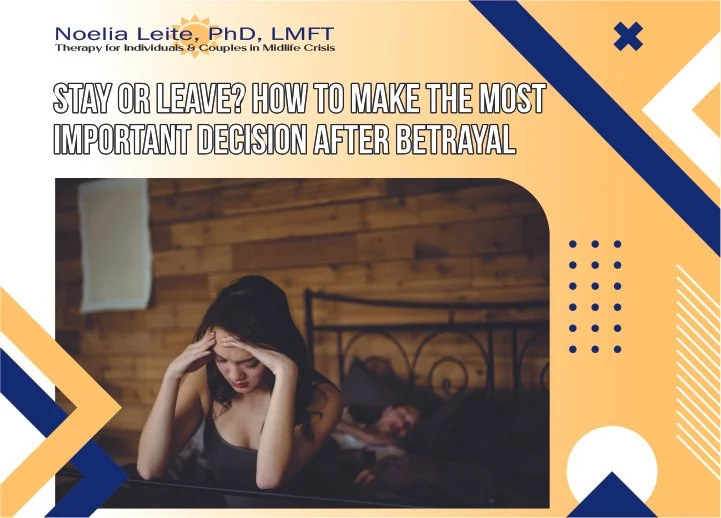
Discovering that your partner has been unfaithful is one of the most destabilizing moments a person can experience. The ground shifts beneath you. The story you told yourself about your relationship, about your life, suddenly feels uncertain. And almost immediately, people around you want to know: Are you staying or leaving?
If you're searching for an answer to that question right now, this is for you.
The truth is, deciding whether to stay or leave after infidelity is not a decision you should rush — and it's rarely as simple as it looks from the outside.
Why the "Stay or Leave" Question Is So Hard
When you're in the aftermath of betrayal, your nervous system is in survival mode. You may feel numb one hour and flooded with rage the next. You may want your partner back desperately and also never want to see them again. Both things can be true.
This emotional whiplash is not weakness. It's a completely normal response to trauma.
The problem is that the people who love you, friends, family, maybe even your therapist, will often have strong opinions about what you should do. Some will urge you to leave immediately. Others will push you to fight for your marriage. And while their advice comes from love, it can add enormous pressure to an already impossible situation.
Here's what many people don't realize: ambivalence after betrayal is not indecision. It's clarity trying to form.

Stay or leave after infidelity? Clarity comes before making a decision.
Questions Worth Sitting with Before You Decide
Whether you're asking should I get divorced or whether there's still something worth saving, certain questions can help you move from reaction toward reflection.
About the betrayal:
Was this a pattern, or a single event? Is my partner honest about it now?
Do I feel like I'm getting the full truth?
Is my partner showing genuine remorse — or just damage control?
About yourself:
What do I need to feel safe again? Is that even possible here?
Who am I outside of this relationship?
What would I tell my closest friends if they were in my situation?
About the relationship:
Was there something worth preserving before the infidelity?
Have we grown apart, or were we genuinely connected?
Am I considering staying out of love, or out of fear?
These aren't questions with easy answers. But they're the right ones to sit with.
Read more: Menopause and Marriage: -How Hormonal Changes Impact Intimacy.

Healing after betrayal takes time, reflection, and emotional support.
What Staying Requires and What Leaving Requires
There's a damaging myth that staying after cheating means you're weak, and leaving means you're strong. The reality is far more nuanced.
Choosing to rebuild after infidelity takes enormous courage. It requires both partners to do deep, sustained work — not just an apology and a promise. The betrayed partner must be willing to gradually rebuild trust without weaponizing the affair indefinitely. The unfaithful partner must be radically transparent, accountable, and patient. Without that mutual commitment, reconciliation rarely holds.
Choosing to leave also takes courage — especially when children, finances, shared history, or religious values are part of the equation. Leaving doesn't mean giving up. Sometimes it means finally choosing yourself.
Neither path is failure. The only wrong choice is the one made purely from panic, pressure, or someone else's expectations.
Understand how it works Digital Infidelity: Is Sexting Considered Cheating?
How Therapy Can Help You Reach Clarity
One of the most valuable things therapy after cheating can offer is a space where you don't have to perform certainty you don't feel.
A skilled therapist — especially one trained in infidelity recovery and trauma — won't tell you whether to stay or leave. That's not their role. What they will do is help you:
Slow down long enough to hear your own instincts beneath the noise
Identify patterns in the relationship that existed before the affair
Understand your attachment style and how it's influencing your response
Grieve what was lost, regardless of what you decide
Make a decision you can live with — one rooted in your values, not your fear
Individual therapy is valuable even if your partner is resistant to couples work. You don't need them in the room to start finding your footing.
Also, see our article about Building Connections: The Power of Peer Support in Group Therapy.

Therapy can help you rebuild trust and make choices rooted in your values.
You Don't Have to Decide Today
If you're in the early weeks after discovering infidelity, please hear this: you do not have to make a permanent decision right now.
Give yourself permission to be uncertain. To gather information about your partner's willingness to change, about your own needs, about what a healthy relationship looks like for you. The decision of whether to stay or leave after infidelity deserves the same care and intention you would give any major life choice, and that takes time.
What matters most right now is that you're not alone in this. Support exists through trusted friends, through community, and through therapy, and reaching out is not a sign of weakness. It's the first step toward clarity.
See also our article about The 5 Stages of Healing from Betrayal Trauma: What to Expect.
About The Author:

Dr. Noelia Leite is an integrative psychotherapist and relationship specialist whose work sits at the intersection of trauma recovery, emotional healing, and advanced couples therapy. With deep expertise in betrayal trauma, sex and multiple addictions, attachment injuries, and complex relational dynamics, she helps couples navigate some of the most painful and destabilizing experiences—rebuilding trust, restoring intimacy, and creating healthier patterns of connection.
She also works extensively with individuals facing anxiety, depression, trauma, identity challenges, and self-worth concerns, offering a compassionate, evidence‑based approach that supports both emotional and physiological healing. Her clinical style blends neuroscience, mind‑body medicine, attachment theory, and experiential therapies, creating a grounded and empowering therapeutic experience.
Dr. Leite holds a Ph.D. in Mind‑Body Medicine with a specialization in Integrative Mental Health, as well as Master degrees in Marriage and Family Therapy and Health Psychology. She is a Licensed Marriage and Family Therapist (LMFT) in several states in the USA, and a licensed clinical and counseling psychologist in Brazil and the United Kingdom. Dr. Leite has numerous years of international practice—including clinical work in Brazil, the United Kingdom, Singapore, Malasia, and Argentina—and expanded her expertise in the United States, deepening her specialization in couples therapy, multiple addictions, trauma treatment, and integrative mental health.
Dr. Leite’s clinical work spans diverse countries and cultural settings, including universities, hospitals, community mental health centers, and both public and private practice. Having lived and worked in several countries—and traveled to nearly 100—she brings a multicultural, philosophically grounded, and spiritually informed perspective to therapy. These experiences deepen her insight into relationships, identity, and healing across cultures.
Her contributions to scientific research and peer‑reviewed publications are recognized in the academic community. She is also a state‑approved supervisor and provides therapy in English, Spanish, and Portuguese.
Based in Miami, Florida, Dr. Leite offers both in-person and online therapy. She helps individuals, couples, and professionals move beyond toxic relationship patterns, unresolved trauma, and limiting emotional cycles to build greater self-awareness, healthier relationships, and lasting well-being. Learn more about Dr Leite.