
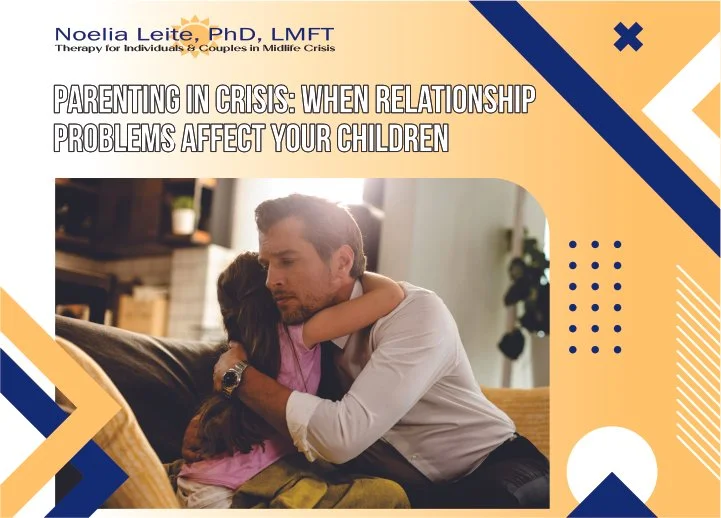
How conflict, addiction, and betrayal trauma ripple into your children's lives — and what family therapy can do about it
Children do not need to be told that something is wrong. They already know. They know it in the way conversations stop when they enter a room. In the tight quality of a hug that is trying too hard to seem normal. In the sounds that travel through walls at night. In the parent who is physically present but somewhere else entirely scrolling, staring, crying quietly in the kitchen when they think no one is watching.
Children are exquisitely attuned to the emotional climate of their home. What they lack is not perception, it is context. And without context, the human brain does what it always does with unexplained threat: it turns inward. Something is wrong. It must be me.
This is what relationship crisis causes children. Not through drama or disclosure, but through atmosphere — through the slow, ambient pressure of a household in pain. Understanding that impact, and knowing how to interrupt it, is what this article is about.
The Invisible Architecture of Family Systems
Family therapy operates on a foundational insight: a family is a system. Every member affects every other member. Stress at one node reverberates through the entire structure. When parents are in crisis — whether navigating betrayal, addiction, compulsive behavior, or chronic conflict — the children are not insulated from that crisis. They are living inside it.
It is not about fault. Parents in crisis are not failing their children by struggling. They are human beings in extraordinary pain, doing the best they can with the resources they have. But understanding the clinical reality of how adult relationship problems travel into children's nervous systems is essential, because awareness is the beginning of protection.
The research is unambiguous: children raised in households with unaddressed parental conflict, addiction, or betrayal trauma show significantly elevated rates of anxiety disorders, depression, behavioral problems, and insecure attachment in adulthood. These are not inevitable outcomes. They are outcomes that respond to intervention. That is the clinically important distinction.
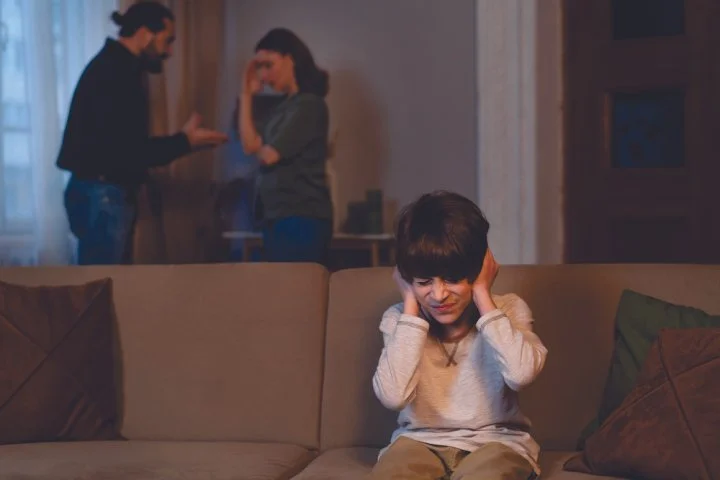
Relationship crises affect children, even when parents try to hide the conflict.
How Relationship Conflict Affects Children's Development
Chronic parental conflict — not the occasional disagreement, but sustained, unresolved tension — activates children's stress-response systems in ways that compound over time.
Dr. John Gottman's research identified what he called spillover: the tendency for marital hostility to erode parenting quality, even in parents who consciously try to keep conflict away from their children. Parents preoccupied with relational pain have diminished emotional availability. They are more reactive, less patient, less able to provide the attuned, regulated presence children need to develop their own emotional regulation skills.
The developmental consequences are concrete:
Infants and toddlers exposed to chronic household conflict show dysregulated cortisol patterns and heightened stress reactivity — a physiological imprinting that shapes the nervous system before language exists.
School-age children frequently internalize blame, show increased anxiety, and demonstrate decline in academic performance and peer relationships.
Adolescents may externalize — acting out, withdrawing from family, self-medicating with substances or screens — or they may parentify themselves, becoming hyperresponsible caretakers to manage the anxiety of watching their family struggle.
None of this is abstract. These are children sitting in classrooms, lying awake at night, trying to make sense of something no child should have to make sense of alone.
Children of Sex Addicts: A Specific and Under-Addressed Population
The clinical literature on children of sex addicts is smaller than it should be, but what exists is consistent and sobering. Children raised in households where a parent is struggling with compulsive sexual behavior — whether pornography addiction, infidelity, or online compulsive behavior — face a specific constellation of challenges.
These children frequently experience:
Emotional unavailability. A parent consumed by addiction is not fully present. The physical body shows up; the attuned, regulated parent does not. Children learn, often without words, that the parent cannot be reliably reached — and this shapes their attachment template.
Household secrecy. Addiction thrives in secrecy, and that secrecy extends systemically into the family. Children sense that something is hidden, that they are not allowed to ask certain questions, that there is a reality running beneath the reality they are shown. Growing up in a system organized around concealment teaches children that honesty is dangerous and that the world is not what it appears.
Secondary betrayal trauma. When the non-addicted parent discovers and begins processing a partner's compulsive sexual behavior, they may become temporarily emotionally unavailable themselves — grieving, enraged, destabilized. Children can lose access to both parents simultaneously, at precisely the moment they most need consistent, regulated adult presence.
Distorted relational modeling. Children learn how relationships work by watching the relationship at the center of their world. When that relationship is organized around deception, manipulation, or emotional abandonment, those dynamics become the child's template — not inevitably, but as a baseline understanding of what intimacy looks like.
Family therapy for children of sex addicts focuses on two parallel tracks: supporting the child's direct experience and rebuilding the parenting structure so that recovery in the adults produces recovery — not further disruption — for the children.
Read more: The Ultimate Guide to Recovering from Betrayal Trauma.

Family therapy helps protect children from the effects of addiction, conflict, and betrayal.
Betrayal Trauma and Its Ripple Effect on Parenting
When one parent has experienced betrayal trauma, their nervous system is in a state of dysregulation — hypervigilant, emotionally volatile, and frequently oscillating between numbness and overwhelm. This is a physiologically normal response to an abnormal experience. It is also, without support, genuinely difficult to parent from.
A parent in acute betrayal trauma may:
React to their child's normal emotional needs with disproportionate intensity
Struggle to maintain routine and structure — the scaffolding children rely on for safety
Inadvertently seeking emotional support from an older child (parentification)
Withdraw emotionally at precisely the moments their child needs them most
Disclose age-inappropriate information when their own regulatory capacity is overwhelmed
None of this makes them a bad parent. It makes them an injured human being trying to parent through an injury. The clinical prescription is not judgment — it is support, both for the adult's healing and for the parenting structure that children depend on.
What Family Therapy Actually Does
Family therapy — especially with a therapist who understands addiction, betrayal, and child development — offers what good intentions alone cannot: a structured, professional setting to stop harmful patterns before they affect a child’s development.
Concretely, family therapy in this context does several things:
Rebuilds the Parenting Alliance
Even in the middle of a relational crisis, parents who are co-parenting children need to function as an aligned team in that specific role. Family therapy helps separate the co-parenting relationship from the romantic relationship — teaching parents to maintain a consistent, united front for their children even when everything between the adults is fractured. This alone is protective.
Creates Age-Appropriate Explanation Frameworks
Children need context. Family therapy provides guidance — often with the children present — on what to say, how to say it, and what to leave out. A skilled therapist can facilitate the kind of honest, boundaried, age-appropriate conversation that most parents in crisis cannot manage alone without either over-disclosing or dismissively minimizing.
Gives Children a Voice
Children in family systems experiencing crisis often feel invisible — aware that something significant is happening but excluded from any acknowledgment of it. Family therapy gives children a sanctioned, safe space to express what they are experiencing, ask the questions they are afraid to ask at home, and receive validation that their perceptions are real and their feelings make sense.
Addresses Parentification
When children have taken on caretaking roles — monitoring a parent's moods, managing their emotional state, carrying secrets — family therapy explicitly addresses this role reversal, returning children to the developmental position they belong in and releasing them from burdens that were never theirs.
Supports Long-Term Resilience
The goal of family therapy in crisis is not just damage control — it is actively building the protective factors that predict healthy adult outcomes: secure attachment, emotional literacy, the experience of watching adults handle difficulty with accountability and repair.
Understand how it works Sexual Anorexia: When Withholding Intimacy Becomes a Weapon.
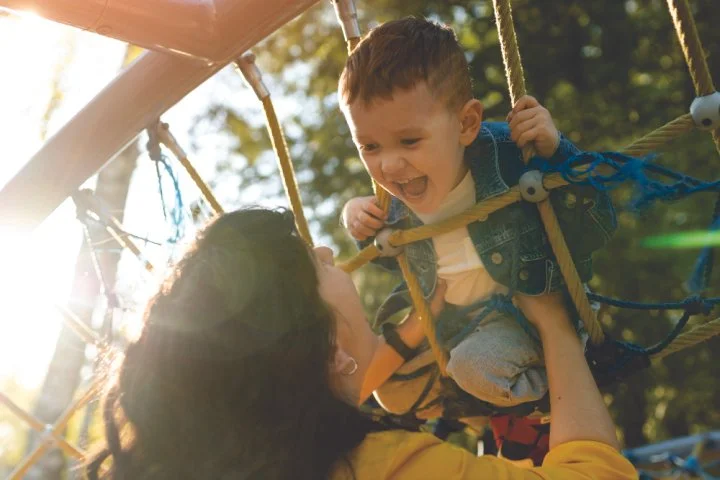
Children need emotional security, consistent routines, and freedom from adult conflicts.
What Children Need Most Right Now
If you are a parent reading this in the middle of something hard — a discovery, a disclosure, an unraveling — here is what the clinical evidence says your children most need from you, right now:
Routine. Predictable mealtimes, bedtimes, school schedules, and rituals signal safety when everything else feels uncertain. Protect routine with the same energy you would protect anything else essential.
Regulated presence. You do not have to have answers. You do not have to be okay. You have to be reachable — warm, present, able to make contact. Even a parent in pain who says "I'm having a hard day, but I love you and I'm here" is providing something genuinely protective.
Honest, boundaried acknowledgment. If children are asking questions — and they usually are, directly or indirectly — they deserve truth in proportion to their developmental capacity. Not full disclosure. Not dismissal. Acknowledgment.
Professional support for yourself. The best thing you can do for your children right now is get help for you. Your regulation is their regulation. Your healing is their safety.
Absolute freedom from adult conflict. They are children. The conflict belongs to the adults. Keep it there.
The Crisis Is Not the Conclusion
Families survive extraordinary disruptions. The research on resilience is, ultimately, a hopeful literature — because what it consistently demonstrates is that it is not the absence of difficulty that predicts children's outcomes. It is the quality of the repair.
Children who watch adults acknowledge a problem, seek help, make changes, and show up differently over time learn something that children in "perfect" households never do: that relationships can break and be mended, that adults can be wrong and accountable, that love is not a static state but an active, ongoing practice.
That is not a consolation. It is a genuinely meaningful outcome — and it is available to your family, from precisely where you are standing right now.
Understand Sex Addiction vs. High Libido: Understanding the Difference.
About the Author

Dr. Noelia Leite is an integrative psychotherapist and relationship specialist whose work sits at the intersection of trauma recovery, emotional healing, and advanced couples therapy. With deep expertise in betrayal trauma, sex and multiple
addictions, attachment injuries, and complex relational dynamics, she helps couples navigate some of the most painful and destabilizing experiences—rebuilding trust, restoring intimacy, and creating healthier patterns of connection.
She also works extensively with individuals facing anxiety, depression, trauma, identity challenges, and self-worth concerns, offering a compassionate, evidence‑based approach that supports both emotional and physiological healing. Her clinical style blends neuroscience, mind‑body medicine, attachment theory, and experiential therapies, creating a grounded and empowering therapeutic experience.
Dr. Leite holds a Ph.D. in Mind‑Body Medicine with a specialization in Integrative Mental Health, as well as Master degrees in Marriage and Family Therapy and Health Psychology. She is a Licensed Marriage and Family Therapist (LMFT) in several states in the USA, and a licensed clinical and counseling psychologist in Brazil and the United Kingdom. Dr. Leite has numerous years of international practice—including clinical work in Brazil, the United Kingdom, Singapore, Malasia, and Argentina—and expanded her expertise in the United States, deepening her specialization in couples therapy, multiple addictions, trauma treatment, and integrative mental health.
Dr. Leite’s clinical work spans diverse countries and cultural settings, including universities, hospitals, community mental health centers, and both public and private practice. Having lived and worked in several countries—and traveled to nearly 100—she brings a multicultural, philosophically grounded, and spiritually informed perspective to therapy. These experiences deepen her insight into relationships, identity, and healing across cultures.
Her contributions to scientific research and peer‑reviewed publications are recognized in the academic community. She is also a state‑approved supervisor and provides therapy in English, Spanish, and Portuguese.
Based in Miami, Florida, Dr. Leite offers both in-person and online therapy. She helps individuals, couples, and professionals move beyond toxic relationship patterns, unresolved trauma, and limiting emotional cycles to build greater self-awareness, healthier relationships, and lasting well-being. Learn more about Dr Leite.